 AI LEARN 2025
AI for Frontend Developers
Workshop
May 28-30, 2025 Warsaw & Online
With over a decade of experience, we've earned the trust of developers who come to our workshops to grow, explore, and level up.
Start Building with AI- Hands-on AI development skills
- Deep understanding of AI agents & RAG
- Full access to recordings & materials
Why Join?
Create next-gen user interfaces with Angular
Build fast, responsive UIs that stream AI-generated content in real time. Use Angular and the Vercel AI SDK to create truly dynamic frontend experiences that feel intelligent and seamless.

Power up your apps with Retrieval-Augmented Generation
Go beyond basic AI. Learn how to use vector databases and RAG techniques to give your applications real-time access to external knowledge, enabling smarter, more accurate responses.
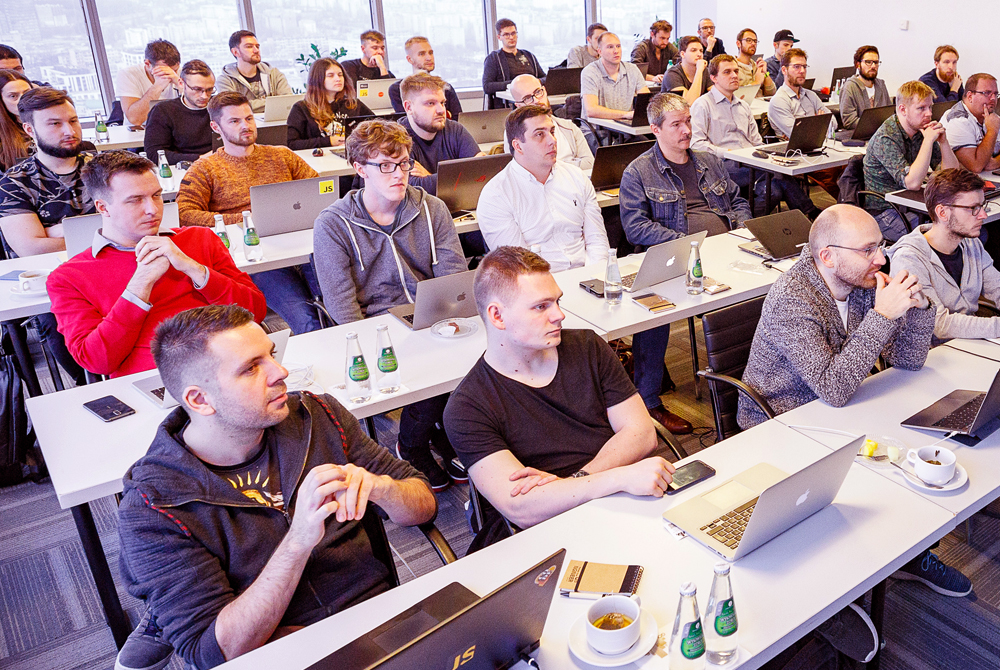
Build real AI agents with TypeScript
Get hands-on with LangChain and OpenAI to create intelligent, backend-connected agents. Learn how to structure prompts, call LLM APIs, and design systems that think and respond like real assistants.
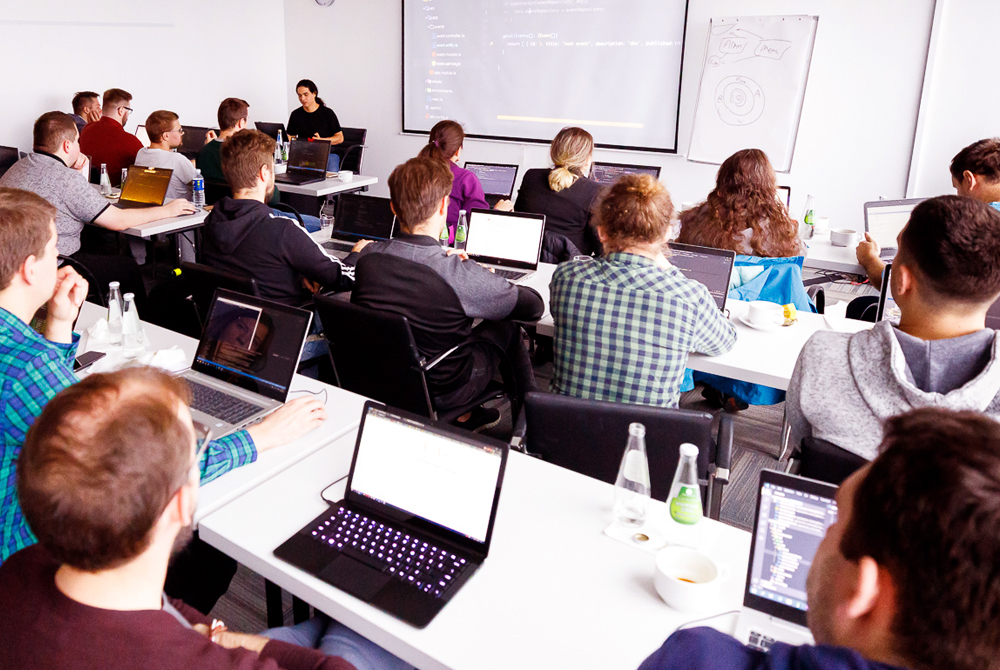
Workshop description
Supercharge your frontend development skills by integrating AI-powered capabilities into your applications! This hands-on 3-day workshop is designed for intermediate and advanced frontend developers who want to leverage their existing TypeScript and Angular expertise to build cutting-edge AI-driven applications.
What you'll learn
- Learn by Doing - Code real AI-powered applications with TypeScript & Angular
- Master AI Agents - Build and enhance AI-driven workflows with LangChain & OpenAI
- Implement RAG (Retrieval-Augmented Generation) - Integrate vector databases for smarter AI responses
- Create Dynamic UI for AI Apps - Stream and render LLM-powered content with Angular & Vercel AI SDK
- Boost Your Career - Stay ahead in the AI revolution and enhance your frontend development toolkit
This workshop is your fast-track to AI mastery, allowing you to build, enhance, and deploy AI-powered applications—all with TypeScript, Angular, and cutting-edge AI frameworks.
🔥 Join us and take your frontend skills into the future! 🔥
Day 1
Introduction to AI and Building Agents with TypeScript
Objectives: By the end of Day 1, participants will grasp fundamental AI terminology and concepts, understand how Large Language Models (LLMs) and AI agents work, and build a simple AI agent using TypeScript. They will also learn prompt-crafting techniques for effective AI responses.
Introduction
Overview of core AI concepts, terminology, and practical applications relevant to frontend developers. We'll discuss what “AI” means in a web development context and explore real-world use cases of AI across industries (from healthcare to finance) to illustrate how these concepts can enhance user experiences. This sets the stage for why frontend developers should care about AI capabilities in their applications.
Understanding LLMs and AI Agents
Introduction to large language models and the idea of AI agents. We'll explain how LLM-based agents operate - an agent is a system that uses an LLM to decide which actions to take based on input and can interact with various tools or data sources. The session will clarify the difference between structured data (fixed-schema data like JSON or database entries) and unstructured data (free-form text, images, etc.) and how each is handled by AI models. This foundation helps developers understand how an agent can bridge user queries with underlying data.
Hands-on
Implementing a basic AI agent using TypeScript and LangChain. Attendees will implement a feature that integrates LangChain with LLM API to create a simple chatbot agent. This agent will accept user input, send it to an LLM, and return the response. Through this exercise, participants get practical experience in constructing an AI-driven backend component.
Understanding Prompts and the LLM API
Fundamentals of prompt engineering and making API calls to LLM. We cover how to structure prompts to guide the model's output (e.g., providing clear instructions or examples) and demonstrate the impact of prompt clarity on response quality. Participants will also learn best practices like including system messages or using temperature settings for tuning output. This knowledge enables developers to fine-tune AI behavior without changing code.
Workshop Exercise
Building an interactive agent. In this end-of-day exercise, you will create a simple web-based chatbot that uses TypeScript to send user queries to their agent/back-end and display the AI's responses. This consolidates Day 1 learnings into a mini-project where you will demonstrate a full loop from user input to AI-powered output.
Day 2
Advanced Agent Development with RAG (Retrieval-Augmented Generation)
Objectives: By the end of Day 2, participants will understand the limitations of standalone LLMs and how Retrieval-Augmented Generation (RAG) addresses them. They will learn to integrate a vector database with LangChain to equip their AI agent with a knowledge base, enabling it to retrieve relevant information. Participants will manage more complex AI workflows (multi-step prompts, conversation state) and enhance their Day 1 agent with RAG for more dynamic, accurate responses.
Introduction
Why we need Retrieval-Augmented Generation and its benefits. We discuss how even powerful LLMs can produce incorrect or outdated answers when acting only on their built-in training data, and how RAG helps solve this. RAG is introduced as a technique to optimize an LLM's output by retrieving external knowledge and feeding it into the model's prompt, rather than relying solely on the model's memory. This allows our AI agents to give more relevant, up-to-date answers without retraining the underlying model. Key benefits - reducing hallucinations, providing current information, and giving the developer more control over responses - are highlighted as motivations for using RAG.
Exploring Vector Databases
Understanding how we store and retrieve AI-relevant data. We introduce vector databases (semantic indexes) as the backbone of RAG, explaining that they store embeddings (numerical representations) of text/data to enable similarity search. When a query comes in, the system generates an embedding for the query and searches the vector database for semantically similar content. This allows the agent to find relevant pieces of information even if exact keywords don't match. We'll cover how vector search works (using techniques like approximate nearest neighbors to quickly find top-matching vectors) and why this approach is effective for pulling context (like knowledge base articles or documentation) that the AI can use to formulate answers.
Hands-on
Integrating LangChain and a vector database to improve our agent's capabilities. In this coding exercise, participants will extend the Day 1 TypeScript agent to use RAG. This demonstrates the typical RAG flow: retrieve, then generate.
Workshop Exercise
Enhancing the AI assistant with RAG for dynamic query resolution. In the Day 2 project, participants will take the chatbot/agent from Day 1 and upgrade it with a knowledge retrieval ability. This exercise simulates a real-world scenario like a support chatbot. By completing this, attendees see firsthand how RAG enables sophisticated chatbots that answer questions about specific source content.
🎉 Evening Social: Party at Hard Rock Cafe Warsaw 🎉
After an intensive day of coding and learning, all onsite participants are invited to unwind at our exclusive networking party at Hard Rock Cafe Warsaw. Each attendee will receive a voucher for a delicious burger and a drink of choice. It's the perfect opportunity to connect, celebrate, exchange ideas, and simply have a great time with fellow developers in a relaxed atmosphere.
Day 3
UI for LLM-Driven Applications with Angular
Objectives: By the end of Day 3, participants will have mastered how to build interactive, responsive user interfaces that effectively integrate AI-driven functionalities. They will be proficient in handling real-time streaming of AI responses, managing complex state for dynamic content updates, and optimizing Angular applications for high performance in AI contexts. Additionally, participants will gain practical insights into deploying AI-powered Angular applications in production environments.
Introduction: Challenges and Opportunities in LLM-Driven UIs
This session explores the unique challenges associated with rendering and managing dynamic, AI-powered content within a web interface. We will address issues such as handling asynchronous data streams, mitigating latency, and ensuring a seamless user experience. Participants will learn how Angular's reactive architecture and best practices in state management can be leveraged to overcome these hurdles.
Understanding Angular for AI Applications
In this segment, we delve into Angular's component-based architecture, data binding, and change detection mechanisms. We illustrate how these features make Angular a robust framework for building AI-driven interfaces. Discussion will include effective modular design, integration of real-time data services, and strategies to maintain responsiveness under high-frequency updates.
Hands-on
Implementing Real-Time Streaming UI with the Vercel AI SDK Participants will integrate the Vercel AI SDK into an Angular project to create a live chat interface that streams AI-generated content in real time. This practical exercise covers setting up Angular services for API integration, configuring components to handle asynchronous events, and rendering dynamic content efficiently, ensuring a fluid interaction between the user and the AI backend.
Managing State and Performance Optimization
Given the dynamic nature of AI-driven applications, efficient state management is critical. This section covers strategies for managing application state using Angular services and state management libraries. Topics include optimizing change detection cycles, implementing debouncing techniques, and leveraging lazy loading to handle frequent updates and large datasets while ensuring optimal performance.
Deployment Best Practices for AI-Powered Angular Applications
The final segment introduces best practices for deploying Angular applications with integrated AI functionalities. Participants will explore configuring production builds, optimizing performance for end users, and utilizing modern deployment platforms such as Vercel. Emphasis is placed on ensuring that real-time streaming and dynamic state management features perform seamlessly in a production environment.
Workshop Exercise
Creating a Dynamic AI Chatbot with Angular and the Vercel AI SDK In this comprehensive exercise, participants will build an end-to-end dynamic AI chatbot application. The project combines all the elements learned during the day—from real-time data streaming and state management to performance optimization and deployment—resulting in a fully functional, deployable AI-powered interface.
Nir Kaufman
We're honored to welcome back Nir Kaufman — an exceptional trainer, developer, and thought leader who has been with us since the very beginning. Nir has already trained over 1,000 developers through our conferences and workshops, and we're proud to have him once again leading this hands-on experience for our growing AI community.
Nir is a seasoned expert in web development — a developer, author, consultant, and Google Developer Expert in Angular and Web Technologies. He's also the founder of Tech a Hike, the world's first off-road tech community. When he's not sharing his deep technical knowledge, he enjoys producing music and guiding 4x4 adventures. Oh — and yes, he's vegan (but totally chill about it 😉).
Still Have Any Questions?
Check out the FAQs.
AI Learn is our workshop series focused on high-quality, hands-on learning experiences for modern developers. This AI workshop is part of the AI Learn lineup, designed to help you apply cutting-edge technologies in real-world projects.
The workshop is led by expert practitioners with years of experience in Angular, TypeScript, AI, and large-scale application development. You'll be learning directly from professionals who build and ship real AI-powered products.
Simply click the “Register” button on this page. You'll be redirected to our ticket platform, where you can purchase tickets for this workshop and also for our conferences: ng-poland.pl, js-poland.pl, and ai-poland.pl.
Yes, we do! For team or group registrations, contact us at darek@ai-poland.pl and we'll prepare a special offer for you.
Yes, we provide VAT invoices for all purchases. You'll receive the invoice automatically after completing your order.
Both! The workshop is a hybrid event, streamed live online and held onsite in Warsaw at the same time. Choose the format that suits you best.
Yes! After the event, once the recordings are edited, you'll get unlimited lifetime access to all videos and materials via our dedicated learning platform.
If you're in Warsaw on Day 2 — absolutely yes!
Even with an online ticket, you're very welcome to join the evening party at Hard Rock Cafe Warsaw. Just let us know in advance so we can prepare your burger & drink voucher! 🍔🥤
The event is organized by NG Poland. The organizer reserves the right to change the date, location, or format of the event — including moving it entirely online — without prior notice. The organizer is not responsible for any costs incurred by participants as a result of such changes. In the event of cancellation, the registration fee will be fully refunded.
Workshop Location & Contact
-
Browary Warszawskie - ADN Conference Center
56 Grzybowska Street, Building GH “Biura przy Warzelni”
00-844 Warsaw, Poland - May 28-30, 2025 | Warsaw & Online
- +48 664 931 800
- darek@ai-poland.pl